Discover Taurus: Strength, Stability, and Determined Ambition
12ZodiacSign unveils the essential Taurus personality traits that drive success and reliability in business and life.
Fundamental Traits and Astrological
Dates
Taurus spans from April 20 to May 20. This earth sign represents stability, persistence, and a grounded nature.
Element
Ruled by the Earth element, Taurus embodies practicality, reliability, and an affinity for the material world.
Ruling Planet
Venus governs Taurus, bringing sensuality, beauty, and a love for comfort and luxury.

Taurus: Practicality Meets Unique Character

The Taurus personality embodies grounded practicality paired with distinct individuality. Known for reliability and focus, Taurus brings steady strength to every challenge.
With a patient yet determined nature, Taurus remains calm under pressure and consistently pursues tangible results. Uniqueness shines through their careful choices and strong convictions.
At 12ZodiacSign, we celebrate the balanced blend of steadfastness and originality that defines every Taurus individual. Explore how this sign’s traits enhance relationships, career, and personal growth.
Taurus in Love and Friendship

Taureans build deep, lasting relationships grounded in trust and loyalty. Their steady nature ensures partners and friends feel secure and valued.
Known for patience and thoughtful communication, Taurus fosters harmony in social dynamics. Their dependable presence is a foundation for mutual growth.
Practical gestures and consistent support characterize Taurus’ way of expressing love. They cherish meaningful connections over fleeting encounters.

Taurus Practical Career Path
Taurus individuals excel in steady, reliable careers that value patience and persistence. Practical and grounded, they thrive in roles involving finance, real estate, and management.
Known for their strong work ethic, Taureans bring consistency and trustworthiness to teams, making them excellent long-term collaborators.
Financial guidance tailored for Taurus focuses on building wealth through stable investments and prudent savings, aligned with their cautious nature.
Stable Industries
Careers in finance, agriculture, real estate, and luxury goods suit Taurus’ need for stability and tangible results.
Key Strengths
Practicality, patience, and persistence are core strengths that enable lasting success and financial security.
Financial Tips
Prioritize careful budgeting and long-term investments to build reliable wealth without risky gambles.
Venus Influence Deep Dive
Discover the profound impact Venus has on Taurus traits. Venus shapes Taurus’ natural charm, sensuality, and steady determination.
This planetary influence brings balance, beauty, and harmony to Taurus individuals, fueling their love for comfort and the arts.
Dive deeper to understand how Venus empowers Taurus with loyalty, patience, and grounded passion.

Taurus Path to Self Discovery
Embrace the steady strength of Taurus to unlock your true potential. Self-growth begins with grounding yourself in patience, persistence, and inner value.
Discover how embracing your natural resilience and determination leads to meaningful transformation and long-term success.
At 12ZodiacSign, we guide you through a journey of self-awareness and empowerment inspired by Taurus's balanced approach.

Taurus Constellation Key Facts
I find that Taurus the Bull is often the first constellation that captures a new stargazer’s heart. It serves as a vital anchor in the winter sky, blending immense scientific significance with sheer visual beauty. As a primary feature of our celestial maps, understanding its basic structure is the first step to mastering the night sky.

Essential Stargazing Data
- Size and Ranking: Covering 797 square degrees, Taurus is the 17th largest constellation in the sky, providing a massive canvas for deep-sky exploration.
- Zodiac Status: It is a prominent zodiac constellation Taurus, positioned directly along the ecliptic—the path the Sun, Moon, and planets follow across the sky.
- Best Viewing Window: While it begins to peek over the horizon in autumn, it is a definitive winter constellation in the Northern Hemisphere. You will find it at its peak visibility from November through March.
- Brightest Star: The constellation is anchored by Aldebaran, a fiery orange giant and the 14th brightest star in the sky, located approximately 65 light-years away.
Coordinate Boundaries
For those using equatorial mounts or digital tracking, here are the Bull's official boundaries:
| Metric | Range |
|---|---|
| Right Ascension | 3.38h to 5.98h |
| Declination | -1.35° to +31.1° |
| Visible Latitude | Between +90° and -65° |
Taurus is more than just a collection of stars; it is a gateway to the cosmos. Whether you are tracking the Aldebaran star or searching for the Pleiades Seven Sisters, this constellation remains a reliable guide for every observer.
How to Find Taurus Constellation and Best Observation Tips
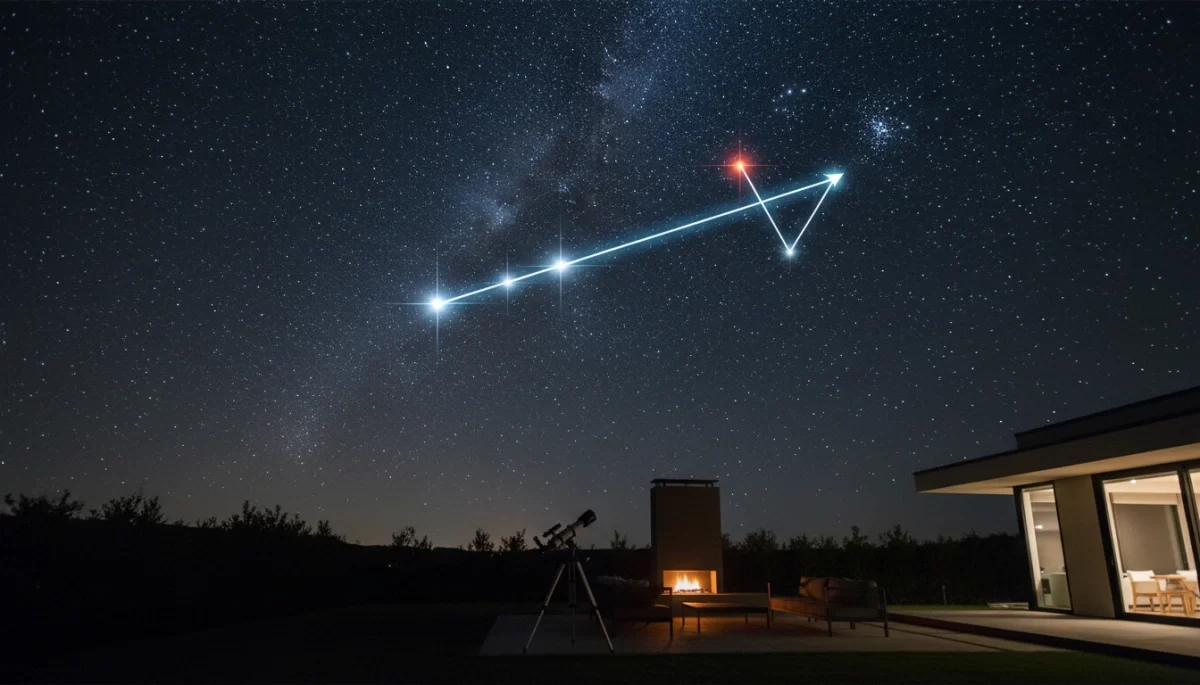
Finding the Taurus the Bull constellation is straightforward once you know how to use Orion as your celestial guide. We recommend the "star-hopping" method, which is the most reliable way to identify the Bull’s features in the winter constellation Northern Hemisphere sky.
Step-by-Step Guide to Spotting the Bull
- Start with Orion’s Belt: Locate the three bright stars in a row that form the Hunter's belt.
- Follow the Path: Draw an imaginary line through the belt stars and extend it toward the right (or upward in the Northern Hemisphere).
- Find the Red Eye: The first bright, fiery orange star you encounter is Aldebaran, the eye of the bull.
- Spot the V-Shape: Aldebaran sits within a distinct V-shaped group of stars known as the Hyades star cluster, representing the bull's face.
Best Timing and Sky Conditions
The best time to see Taurus is from November through March. For the most impressive views, look up during December and January evenings when the constellation reaches its highest point in the sky. While we often discuss the traits of the Taurus zodiac sign in a symbolic sense, seeing the physical constellation provides a unique perspective on its grounded, powerful energy.
Observation Tips for Different Environments
- Urban Areas: Even with light pollution, Aldebaran star and the Pleiades Seven Sisters are usually bright enough to see with the naked eye.
- Dark-Sky Locations: From a rural spot, the V-shaped Hyades become much denser, and you can begin to see the faint glow of the Crab Nebula M1 with basic equipment.
- Binoculars vs. Telescopes: A pair of 10x50 binoculars is actually the best way to view the large open star clusters Taurus hosts. A telescope is only necessary if you want to resolve the structure of distant nebulae.
- The Winter Hexagon: Use Taurus to find the "Winter Hexagon" asterism. Aldebaran serves as one of the six corners, connecting Taurus to other bright stars like Rigel, Sirius, and Capella.
The Brightest Stars of Taurus Constellation
I focus on the core anchors that make Taurus the Bull constellation a standout in the night sky. Identifying these stars is the first step for any observer looking to master the winter hexagram. While summer stargazers might look for the sharp sting of Scorpio, the winter belongs to the fiery gaze and massive horns of the Bull.
Aldebaran: The Eye of the Bull
Aldebaran is the most famous Aldebaran star and the 14th brightest in the entire sky. It marks the Bull’s bloodshot eye with a distinct orange hue.
- Type: An orange giant (K5III).
- Distance: Located roughly 65 light-years from Earth.
- Visuals: It sits in front of the Hyades cluster but isn't actually part of it; it's just a line-of-sight coincidence.
Elnath and the Bull’s Horns
The tips of the horns are defined by two significant stars. Elnath (Beta Tauri) is the Elnath horn star, marking the northern tip. It is a blue-white giant so close to the border of Auriga that it is often shared between the two constellations. The southern horn is marked by Zeta Tauri (Tianguan), a binary star system that serves as a guidepost for finding the Crab Nebula.
Notable Members: Alcyone and T Tauri
Beyond the main figure, Alcyone stands out as the brightest member of the Pleiades Seven Sisters. For those interested in stellar evolution, T Tauri is a vital variable star. It is the prototype for a class of young stars that haven't yet reached the main sequence, often found nestled within the Taurus deep sky objects. Much like the late-year transition into Sagittarius, these stars represent a dynamic and active region of our galaxy.
Comparison of Primary Taurus Stars
| Star Name | Popular Name | Magnitude | Distance (Light Years) | Spectral Type |
|---|---|---|---|---|
| Alpha Tauri | Aldebaran | 0.87 | 65 | K5III |
| Beta Tauri | Elnath | 1.65 | 134 | B7III |
| Zeta Tauri | Tianguan | 3.01 | 440 | B2III |
| Eta Tauri | Alcyone | 2.87 | 440 | B7III |
| T Tauri | T Tauri | Variable | 460 | F8-K1 |
These stars aren't just points of light; they are the structural pillars of the Zodiac constellation Taurus. Understanding their distance and magnitude helps you appreciate the sheer scale of the Bull as it charges through the ecliptic.
Iconic Deep-Sky Objects in the Taurus Constellation

We track the most spectacular deep-sky targets within the Taurus the Bull constellation, offering a roadmap to some of the most studied structures in modern astronomy. This region contains a mix of young stellar nurseries and the remnants of violent stellar deaths.
The Pleiades (M45): The Seven Sisters
The Pleiades Seven Sisters is arguably the most famous of all open star clusters Taurus hosts. It serves as a focal point for observers due to its high visibility and striking blue hue.
- Distance: Roughly 444 light-years from Earth.
- Age: Estimated at 100 million years.
- Observation: Clearly visible to the naked eye; binoculars reveal dozens of additional stars within the cluster.
The Hyades Star Cluster
The Hyades star cluster forms the distinct "V" shape that represents the Bull's face. As the closest open cluster to our solar system, it is a primary laboratory for astronomers studying stellar evolution.
- Distance: 150 light-years.
- Context: While the bright star Aldebaran looks like it belongs to this group, it is actually a foreground star and not a physical member of the cluster.
The Crab Nebula (M1): Supernova Remnant
The Crab Nebula M1 is a cornerstone of celestial history. This supernova remnant Crab Nebula is the debris from a massive star that exploded in 1054 AD, an event so bright it was visible during the day for weeks.
- Core: At its center lies the Crab Pulsar, a rapidly spinning neutron star.
- Significance: It is the first Messier object and remains one of the most studied Taurus deep sky objects.
Star-Forming Regions and Clusters
Beyond the main highlights, the Taurus-Auriga complex is a massive star-forming region where new stars are currently coalescing from interstellar gas.
| Object | Type | Key Feature |
|---|---|---|
| Pleiades | Open Cluster | Young blue stars |
| Hyades | Open Cluster | Bull's face shape |
| Crab Nebula | Supernova Remnant | Pulsar at the center |
| NGC 1647 | Open Cluster | Located near the Bull's horns |
Our expertise extends across the celestial sphere, providing detailed guides for everything from these deep-sky wonders to the personality traits of a Cancer or the analytical nature of a Virgo.
Mythology and Cultural History of Taurus

The Taurus Constellation Overview would be incomplete without acknowledging that this is one of the oldest documented patterns in the night sky. We see evidence of its importance as far back as 15,000 BC in the Lascaux cave paintings. During the Bronze Age, the bull was even more vital, as it marked the spring equinox and symbolized the return of life.
The Bull of Heaven and Greek Legends
The Taurus mythology Zeus Europa tale is the most enduring legend in the West. Zeus famously transformed into a magnificent white bull to win the heart of Princess Europa, eventually carrying her across the Mediterranean. However, its roots go deeper:
- Mesopotamia: It appears in the Epic of Gilgamesh as the "Bull of Heaven."
- Greek Alternative: Some traditions claim the stars represent Io, a priestess whom Zeus turned into a heifer to hide her from Hera.
- Celestial Position: In the sky, the bull appears to charge at Orion, situated right after the bold energy of Aries in the zodiac sequence.
Global Cultural Perspectives
The impact of the Taurus the Bull constellation spans nearly every major ancient civilization, proving its universal appeal.
- Egypt: It was associated with the sacred Apis bull, a symbol of strength and renewal.
- Babylon: Ancient tablets refer to it as GUD.AN.NA, the "Steer of Heaven."
- China: This region of the sky was known as part of the White Tiger of the West.
- Druids: The Bull was a religious icon, with major festivals timed to the sun’s entry into this constellation.
We view these diverse origins as the foundation for how we interpret all zodiac signs today, bridging the gap between ancient survival and modern astronomical wonder.
Taurus Astronomy Events in 2026

2026 is a standout year for the Taurus the Bull constellation. Between a major planetary transit and our annual meteor displays, the "Bull" is taking center stage in the night sky. I’ve highlighted the key dates you need to mark on your calendar to ensure you don't miss these celestial highlights.
Jupiter Transiting Through Taurus
Throughout the early months of 2026, Jupiter is transiting through Taurus. As the largest planet in our solar system, its presence makes the constellation exceptionally easy to spot, even in light-polluted areas. Jupiter will appear as a brilliant, steady white light situated near the Bull’s horns, providing a stunning contrast to the fiery red glow of Aldebaran.
2026 Taurid Meteor Shower Peaks
The Taurid meteor shower is world-renowned for "fireballs"—meteors that are brighter and last longer than average. In 2026, we are tracking two specific peaks for the best viewing experience:
- Southern Taurids: These reach their maximum activity around November 5, 2026.
- Northern Taurids: This stream peaks roughly a week later, around November 12, 2026.
Because these showers move relatively slowly across the sky, they are perfect for photography and beginner observers.
Observing Tips for 2026 Events
To get the most out of these Taurus constellation highlights, I recommend following these simple steps:
- Timing: For both Jupiter and the Taurids, the best views occur after midnight when Taurus is at its highest point in the sky.
- Location: While Jupiter is visible from your backyard, the Taurid meteor shower requires a dark-sky location away from city glow to see the fainter streaks.
- Equipment: You don't need a telescope for the meteors—your naked eye provides the widest field of view. However, a pair of binoculars will reveal Jupiter’s four largest moons as they sit within the boundaries of Taurus.
Taurus Constellation Overview: Astrology and Zodiac Context
I view the Taurus the Bull constellation as more than just a cluster of stars; it is the foundation for one of the most grounded signs in the zodiac. People born between April 20 and May 20 fall under this sign, which is deeply influenced by the bull's physical strength and the aesthetic grace of its ruling planet, Venus.
Venus-Ruled Traits and Earth Symbolism
As an Earth sign, Taurus focuses on the tangible, the practical, and the enduring. This grounding creates a personality known for its determination and loyalty. When we analyze zodiac compatibility, it is clear that this steady nature makes Taurus a natural match for other Earth signs like Capricorn.
- Ruling Planet: Venus (Governs love, beauty, and value).
- Element: Earth (Represents stability and a focus on the physical world).
- Core Symbol: The Bull (Signifies strength, persistence, and a calm but powerful presence).
Astronomical vs. Astrological Differences
It is important to distinguish between the Zodiac constellation Taurus and its astrological placement. While the zodiac was originally mapped to the stars, a phenomenon called precession—the slow "wobble" of Earth's axis—has caused the two to drift apart over the last 2,000 years.
| Aspect | Astrology (The Sign) | Astronomy (The Constellation) |
|---|---|---|
| Dates | April 20 – May 20 | Mid-May – Late June |
| Primary Focus | Human archetypes and personality | Stellar positions and coordinates |
| Basis | Fixed seasonal cycles | Real-time movement of the Sun through stars |
For those looking to dive deeper into their specific placements or calculations, our collection of astrology tools helps bridge the gap between ancient star patterns and modern personal insights. Understanding these differences ensures you appreciate both the mythic power of the Bull and the scientific reality of the night sky.
🙋 Taurus FAQ: Common Stargazing Questions about the Bull
We get a lot of questions about observing the Taurus constellation and its famous landmarks. Here are quick answers to some of the most common stargazing queries:
- How many stars in Taurus are visible to the naked eye? The number varies based on your viewing conditions, but under good, dark-sky conditions, you can easily spot over 100 stars within the boundaries of the Taurus the Bull constellation. The brightest, like Aldebaran and the stars forming the Hyades star cluster and Pleiades Seven Sisters, are always prominent.
- Where is the best place to view the Pleiades cluster? The Pleiades (M45) are best viewed with naked eyes or binoculars. The cluster is so large that a telescope's narrow field of view often can't capture the entire stunning grouping of Seven Sisters. Look for it high in the sky during the late autumn and winter months.
- Is the Crab Nebula visible without a high-powered telescope? The Crab Nebula (M1), which is the remnant of a historic supernova, is a difficult target. You will need at least a good pair of large binoculars or, preferably, a small to medium-sized telescope to locate this faint, hazy patch. It is not visible to the unaided eye.
- Can you see Taurus from the Southern Hemisphere? Yes! While Taurus is known as a prominent Winter constellation Northern Hemisphere object, it is visible to observers in the Southern Hemisphere, though it will appear lower on the northern horizon and may be harder to see from far southern latitudes. It's best observed during their summer months.
 English
  French
  Japanese
  Korean